










The Unsung Hero Inside Your Speakers: A Guide to Crossovers
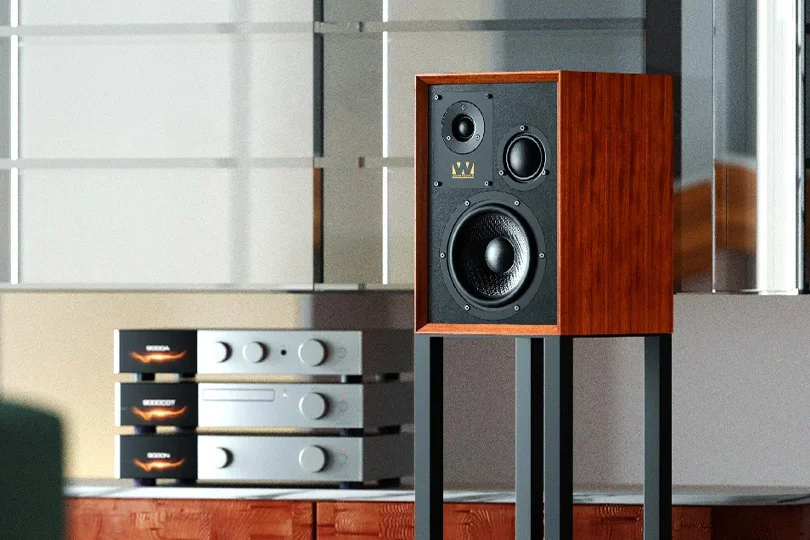
Ever marvel at how a great speaker can deliver booming bass, crystal-clear vocals, and sparkling highs all at the same time? You might admire the drivers, the cabinet, maybe even the fancy port. But the real magic happens inside, thanks to a hidden component that’s arguably the most critical part of any multi-driver speaker: the crossover.
Think of it as the traffic cop or the musical director for your speakers. Let's break down what it does, why it's essential, and how it shapes the sound you hear.
Contents
What is a Crossover, and Why Do Speakers Need One?
Imagine asking a tiny, delicate tweeter (the speaker driver responsible for high frequencies) to reproduce the deep rumble of a bass guitar. It would distort horribly, sound terrible, and probably destroy itself in the process. Similarly, asking a big, heavy woofer to handle the lightning-fast vibrations of a cymbal crash just won't work effectively.
No single speaker driver is perfect at reproducing the entire range of human hearing, 20 Hz to 20 kHz. That's where the crossover comes in.
A crossover is essentially an electrical filter circuit. Its job is to take the full-range audio signal coming from your amplifier and split it into different frequency bands — lows, mids, and highs — sending each band only to the driver designed to handle it. The woofer gets the bass, the tweeter gets the treble, and if it's a three-way speaker, a midrange driver gets the middle frequencies.
How Does It Work? The Magic of Filters
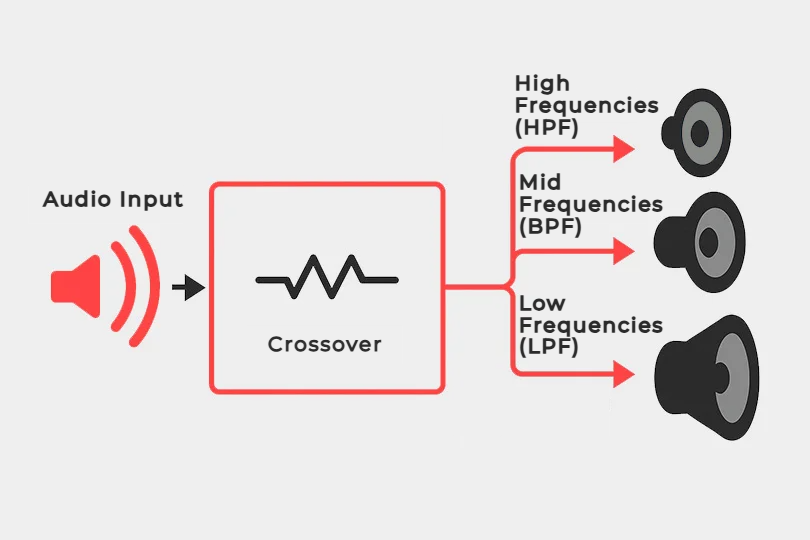
At its core, a crossover uses passive electrical components — primarily capacitors and inductors (aka coils) — to direct the audio traffic.
- Capacitors block low frequencies and allow high frequencies to pass through (acting as a high-pass filter for the tweeter).
- Inductors block high frequencies and allow low frequencies to pass through (acting as a low-pass filter for the woofer).
By combining these, engineers create specific crossover points, aka cutoff frequencies. For example, in a two-way speaker with a crossover point at 2 kHz (2000 Hz), the crossover sends everything below 2 kHz to the woofer and everything above 2 kHz to the tweeter. Three-way speakers have two crossover points, adding a band-pass filter for the midrange driver.
Steep Slopes and Phase Shifts: Getting Technical (Just a Bit!)
Crossovers aren't just simple on/off switches. They gradually "roll off" the frequencies outside a driver's intended range. The steepness of this roll-off is called the slope, measured in decibels per octave (dB/octave).
- 1st Order (6 dB/octave): A gentle slope. Simple design, but allows more frequency overlap between drivers.
- 2nd Order (12 dB/octave): A moderate slope. Good balance between separation and complexity.
- 4th Order (24 dB/octave): A very steep slope. Provides sharp separation but is more complex and can introduce phase shifts.
Phase shifts are tiny timing differences between the frequencies around the crossover point. If not managed carefully, they can smear the soundstage and make the speaker sound less coherent. Designing a great crossover isn't just about choosing frequencies; it's a delicate balancing act to ensure all drivers work together seamlessly, both in frequency and time.
Types of Crossovers: Passive, Active, and DSP
Passive Crossovers
Passive crossovers are the most common type, found inside almost all traditional home speakers. They use the capacitors, inductors, and resistors mentioned earlier and don't require any external power. They sit between the amplifier and the speaker drivers.
- Pros: Simple, cost-effective, and no extra power needed.
- Cons: Can consume some amplifier power, leading to insertion loss; limited tuning options for the user; components can interact with the amplifier in complex ways.
Active Crossovers
Active crossovers require power and sit before the amplifiers in the signal chain (e.g., between your preamp and power amps). In an active system, each frequency band is filtered first, and then each band is sent to its own dedicated amplifier channel connected directly to the corresponding driver.
- Pros: More efficient power delivery, greater control over each driver, flexible tuning thanks to adjustable crossover points and slopes, and reduced distortion (at least, certain types of it).
- Cons: Requires multiple amplifier channels (bi-amping or tri-amping); has a more complex and expensive setup. Often found in high-end studio monitors and advanced Hi-Fi systems.
Digital (DSP) Crossovers
Digital crossovers use Digital Signal Processing chips to perform the filtering in the digital domain, usually before the DAC.
- Pros: Extremely precise control over frequencies, slopes, phase, timing delays, and even room correction. The ultimate in flexibility and accuracy.
- Cons: Requires digital processing (which some purists dislike), can be complex to configure. Standard in professional audio, high-end active speakers, and car audio systems.
Why It All Matters: The Sound Quality Connection
A well-designed crossover is absolutely critical for:
- Clarity: Prevents drivers from distorting by trying to play frequencies they weren't designed for.
- Balance: Ensures a smooth transition between the woofer, midrange, and tweeter, creating a cohesive and natural sound without obvious gaps or peaks.
- Speaker Protection: Protects delicate tweeters from damaging low frequencies, especially at high volumes.
- Imaging & Soundstage: Precise phase alignment through the crossover is vital for creating a stable and realistic stereo image.
The Final Word
The crossover might be hidden from view, but it's the brain dictating how your speaker drivers work together. Whether it's a simple passive network or a sophisticated DSP, its role is indispensable. Understanding the crossover helps you appreciate the engineering artistry that goes into a truly great speaker — one that doesn't just make noise, but makes music.
Crossovers are the unsung heroes inside your speakers, and without them, even the best models wouldn’t sound nearly as great. But thankfully, they do — and if you’re looking to upgrade your home audio setup, come to the Dr.Head showroom in Dubai. There, you can fully test the best speakers and other audio equipment, and our experts will be happy to help.



Brand: Focal
: 44
Connection method: hdmi, optical, rca, usb-a, rj45, bluetooth, wifi


Bluetooth version: 5.3
Cable included: yes
Charging connector: DC-IN

Connection method: wifi, rj45
Phase Inverter location: below
The highest frequency, kHz: 22
Connection method: bluetooth, wifi, rj45, hdmi
Max SPL, dB: 105
Number of lanes: two-lane