


























S/PDIF Explained: The Digital Connection That Refuses to Die
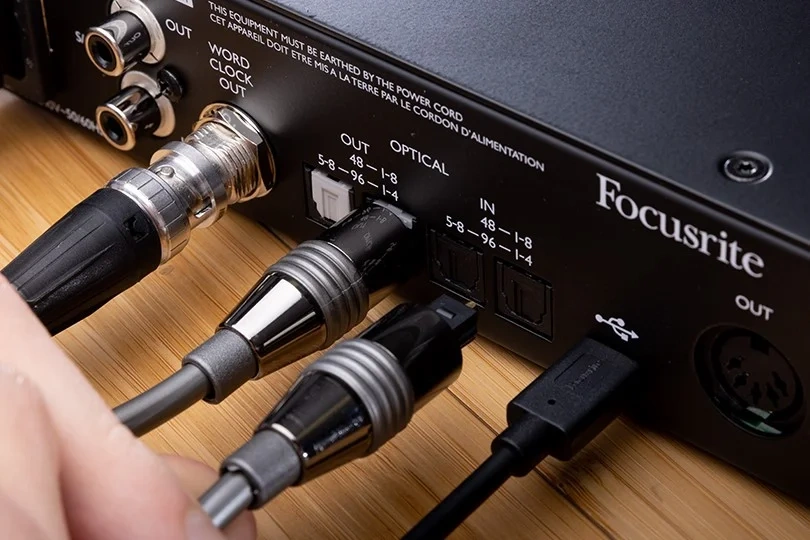
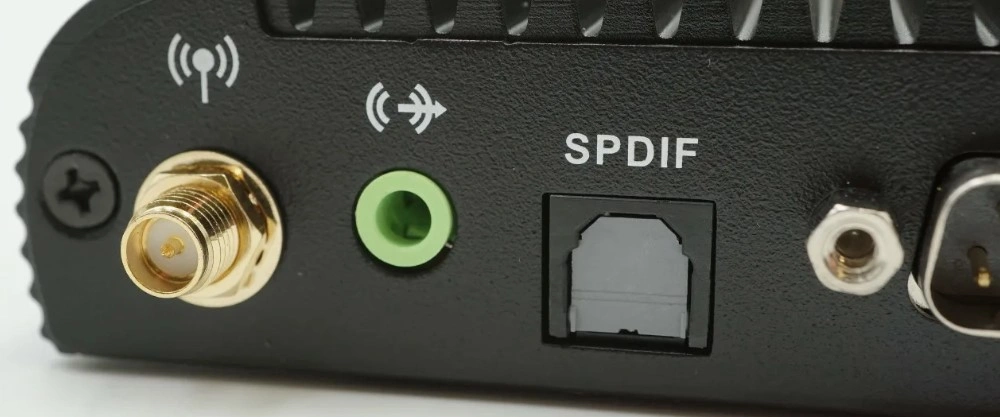
You’ve seen it a thousand times. It’s that mysterious square or round digital port on the back of your TV, amplifier, or sound card, sitting there silently. It has a weird name: S/PDIF. You know it’s for audio, but in a world of HDMI and USB, what’s the point? Is it just a relic from a bygone era?
Not even close.
That humble S/PDIF connection is an old-school hero, a digital audio interface that has been delivering pure, clean sound for over four decades. It was born in the age of CDs, but it’s still incredibly relevant today. What is it, how does it work, and why is it still one of the most reliable tools in your audio arsenal? Let’s dive in.
Contents
The Revolution: What is S/PDIF, Anyway?
In the mid-1980s, two giants of the audio world, Sony and Philips, teamed up to solve a problem. Analog cables, the standard at the time, were susceptible to noise and distortion; the longer the cable, the worse the signal. Their idea was simple but revolutionary: transmit the audio signal digitally, as a pure stream of 1s and 0s, and you could kill the noise.
And so, the Sony/Philips Digital Interface was born. It was based on the professional AES/EBU studio standard but designed for consumer electronics, becoming the bridge between the analog past and the digital future. It was first used to get a perfect digital signal from the pioneering DAT (Digital Audio Tape) recorders and, of course, CD players.
It was a game-changer. Suddenly, you could send a bit-perfect audio stream from your CD transport to an external DAC, preserving every nuance. You could connect your TV to a receiver and get immersive, compressed Dolby Digital or DTS 5.1 surround sound. Even today, it’s used in studios, on stages, and for connecting Blu-ray players and game consoles.
Two Faces of S/PDIF: Coaxial vs. Optical
The S/PDIF standard comes in two flavors. They do the same job but in very different ways.
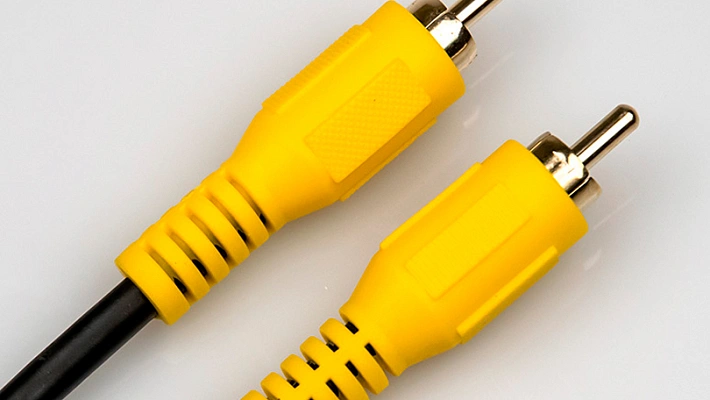
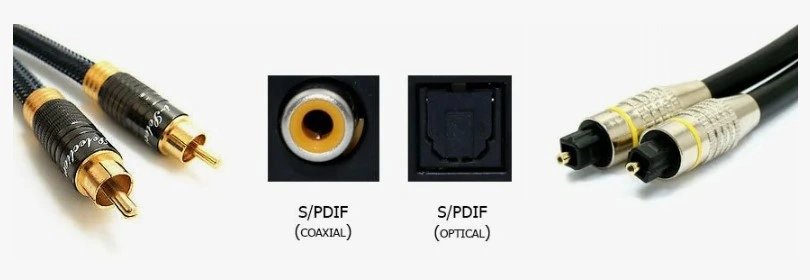
1. Coaxial S/PDIF
This version uses a familiar RCA connector and a special 75-Ohm coaxial cable. It sends the digital signal as electrical pulses.
Why It’s Good: It’s robust, reliable, and can run for longer distances (up to 10 meters or more with a good cable) without signal loss.
Why It’s Not Perfect: Like any electrical connection, it can be susceptible to electromagnetic interference (EMI). If you have a noisy power supply or a massive amplifier nearby, a poorly shielded cable can pick up hum or buzz.
Nerd Trivia
In the 90s, audio enthusiasts would often repurpose standard TV antenna cables for S/PDIF. Sometimes it even worked, but if the impedance wasn't exactly 75 Ohms, it could cause signal reflections and errors.
2. Optical S/PDIF (aka Toslink)
This version, famously invented by Toshiba (hence TOShiba-LINK), sends the digital signal as pulses of light through a fiber-optic cable.
Why It’s Good: Because it uses light, not electricity, it is 100% immune to all electrical and radio-frequency interference. This makes it perfect for setups with a lot of wireless gear or noisy components. Plus, the cool red glow from the end of the cable has a certain visual charm.
Why It’s Not Perfect: The fiber-optic cable is more fragile, and a sharp bend can damage it permanently. The signal also degrades over shorter distances, typically limiting cable length to 5–10 meters.
The Showdown: Coaxial or Optical — Which One Wins?
This isn't about which technology is superior; it's about choosing the right tool for your specific system.
| Type | Connector | Transmission | Cable Length | Interference Resistance | Bandwidth | Cost | Durability |
|---|---|---|---|---|---|---|---|
| Coaxial | RCA | Electrical | Up to 10 m | Medium | Up to 3 Mbit/s | Low | High |
| Optical | Toslink | Light | Up to 5–10 m | High | Up to 3 Mbit/s | Medium | Low |
Choose Coaxial if:
You need to run a longer cable, or if the cable might be bent around tight corners. A high-quality, well-shielded coaxial cable is an incredibly robust and reliable choice.
Choose Optical if:
Your audio system is in a "noisy" environment with a lot of other electronics, like Wi-Fi routers, power conditioners, or big amplifiers. Its immunity to EMI will guarantee a clean signal.
"But It's Digital, Right?" Why Your S/PDIF Cable Actually Matters
This is the big one. There's a common myth that with a digital signal, the cable doesn't matter. "It's just 1s and 0s," the thinking goes, "it either gets there or it doesn't."
In reality, it's far more complex. Those 1s and 0s are not abstract data; they are incredibly fast pulses of electricity or light that must arrive in perfect time.
How 1s and 0s can get lost
The device on the receiving end has to read these pulses and distinguish a "1" from a "0." If the signal gets weak, distorted, or timed incorrectly (a problem known as jitter), the receiver can get confused.
With a bad coaxial cable, signal reflections from improper impedance can act like an echo, smearing the timing. EMI can introduce noise that looks like a signal.
With a bad optical cable, the light pulses can get dispersed and lose their sharp edges, or simply become too dim to be read accurately.
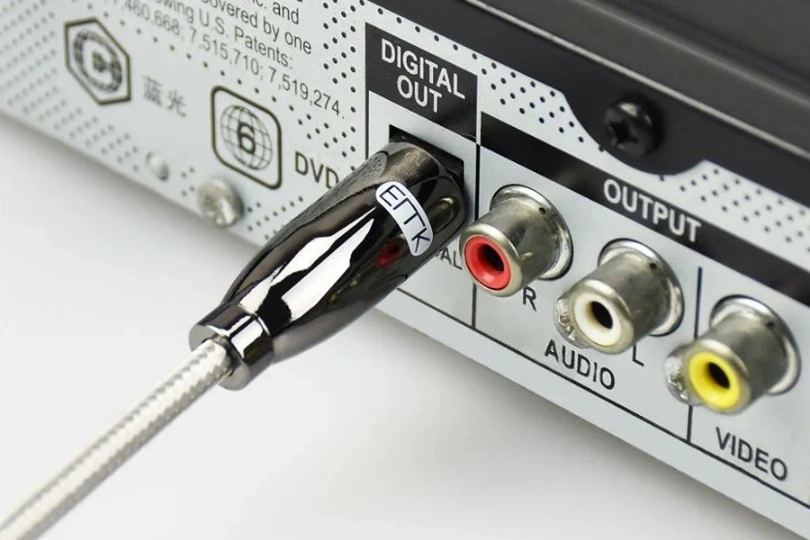
Unlike a small crackle in an analog signal, a digital error can cause audible clicks, pops, brief dropouts of sound, or a complete loss of signal. So yes, even for "just 1s and 0s," a quality, well-made cable is crucial for ensuring that the signal that leaves your source is the same one that arrives at your DAC.
The Verdict: Still a Hero in the Age of HDMI
In a world now dominated by the all-in-one convenience of HDMI, the humble S/PDIF still holds its ground. Why? Because it's a dedicated, no-nonsense, and incredibly reliable standard for pure audio transmission.
For connecting a CD transport to a DAC, a streamer to an amplifier, or a game console to a soundbar, S/PDIF is often the simplest and most effective solution. It has proven its worth for decades, from the first DAT recorders to the most modern high-end systems. We believe that for the foreseeable future, S/PDIF will remain a key tool for anyone who values high-quality sound and elegant simplicity.