




















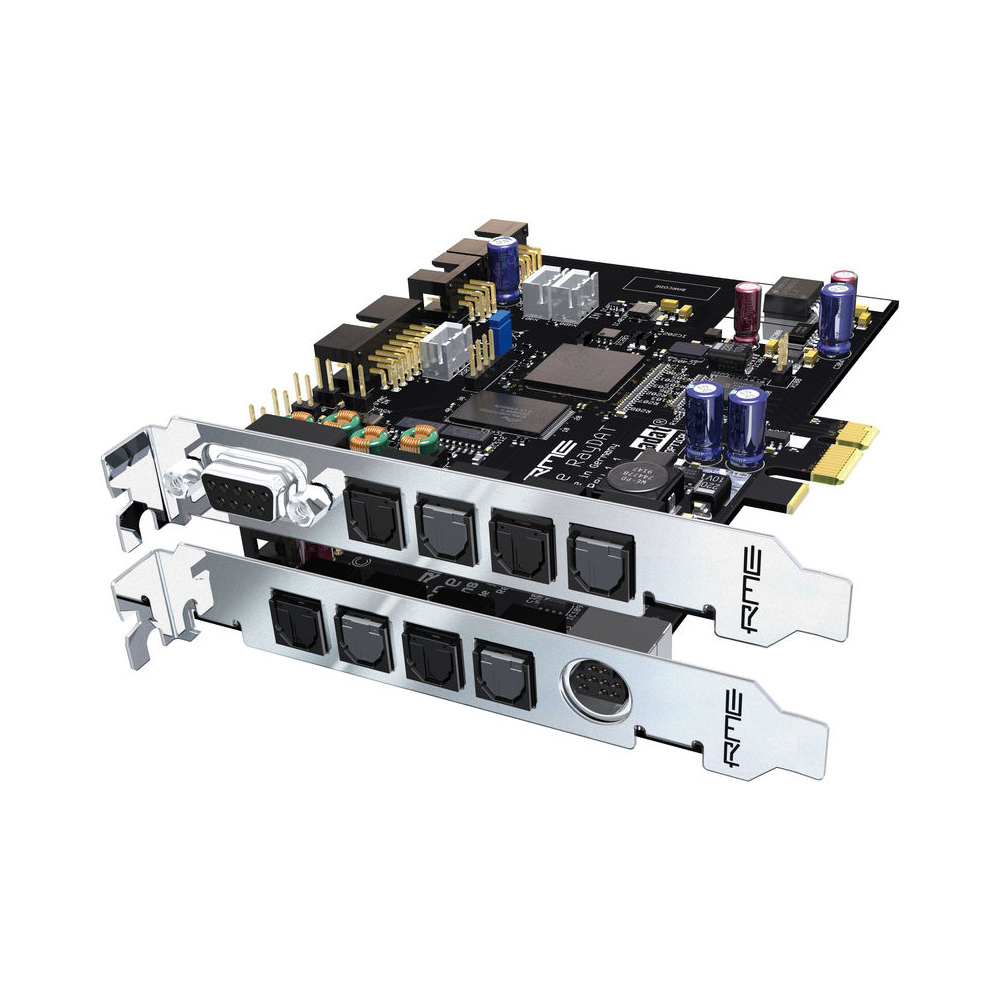
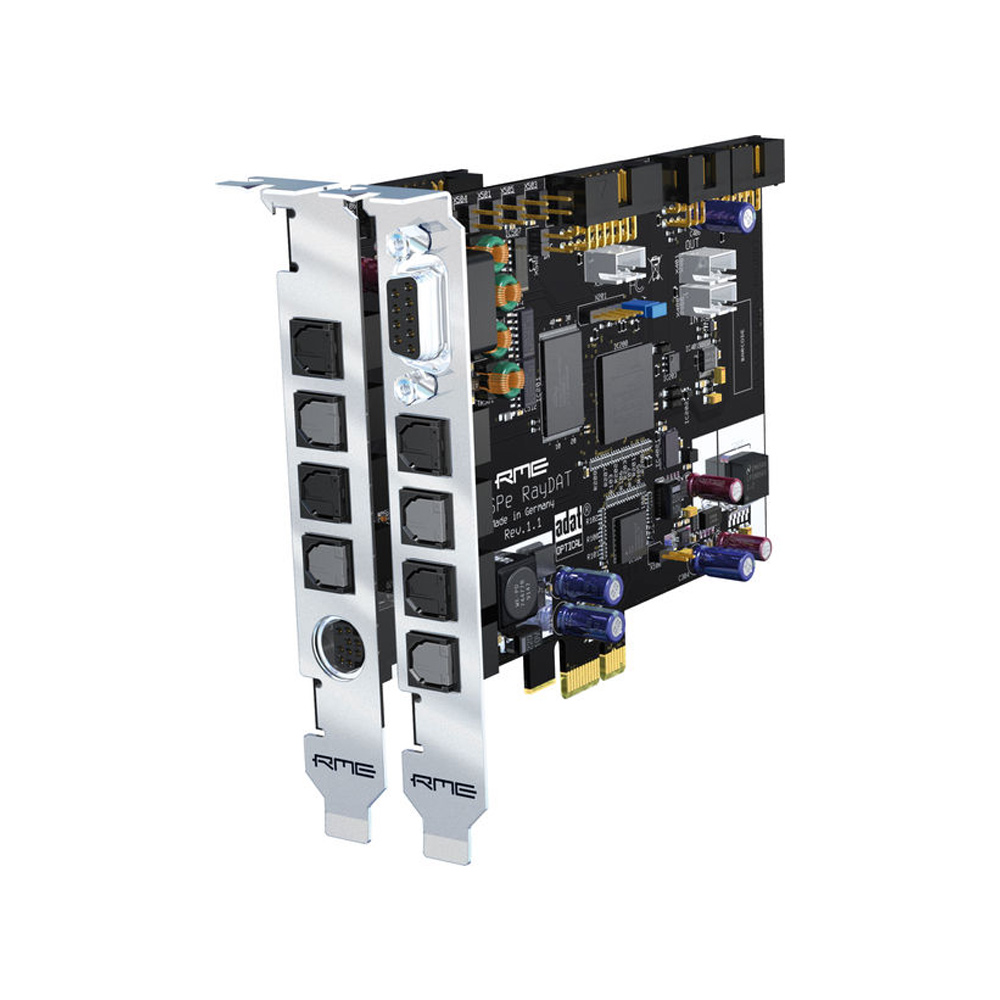

The RME HDSPe RayDAT is a PCIe computer card consisting of two boards: a main board (for PCIe bus) and a daughter board. The RME HDSPe RayDAT differs from the HDSP 9652 by having a fourth optical digital interface, the ability to simultaneously use electric digital interfaces in AES/EBU and SPDIF formats, support for higher sampling frequencies, reduced latency, an improved TotalMix mixer, support for SMPTE and HDSP TCO video synchronization options, the absence of Word Clock input and output, and the absence of an ADAT synchronization port.
Features:
- PCI Express interface
- 4 x ADAT I/O supporting 192kHz via S/MUX4
- Digital SPDIF I/O at 192kHz
- AES/EBU I/O at 192kHz
- 2 x MIDI I/O - 32 channels
- Up to 36 inputs and 36 outputs usable simultaneously
- TotalMix: 2592 channels in the mixer, with internal resolution of 42 bits
- S/MUX - 16 channels at 24-bit/96kHz - recording and playback via optical ADAT
The main board of the RME HDSPe RayDAT includes two eight-channel optical ADAT interfaces, a nine-pin D-Sub connector for an included cable adapter with two-channel electric digital AES/EBU (XLR) and SPDIF (RCA) interfaces. The secondary board of the RME HDSPe RayDAT includes two more eight-channel optical ADAT interfaces, a nine-pin Mini-DIN connector for an included cable adapter with two MIDI inputs and MIDI outputs.
The daughter board is connected to the main board with a cable featuring 14-pin connectors. The RME HDSPe RayDAT supports 24-bit depth and sampling frequencies up to 192kHz. With the RME HDSPe RayDAT, playback and recording of 36 audio channels at 48kHz, 20 channels at 96kHz, and 12 channels at 192kHz is possible simultaneously. The RME HDSPe RayDAT includes a built-in digital mixer TotalMix, and MIDI control of the mixer is also possible.
Package includes:
- Sound card
- Expansion card
- Digital XLR cable
- MIDI cable
- Optical cable
- Manual